
India stands at the cusp of an electronics manufacturing revolution. With a population of over 1.4 billion, rapidly rising disposable incomes, aggressive government policies to boost domestic manufacturing, and a global shift toward supply chain diversification away from China — the Indian PCB market is poised for explosive growth in the coming decade.
In this comprehensive market analysis, the AEAR team examines the forces shaping India's PCB industry, the sectors driving demand, the policy landscape, and what the future holds for manufacturers, suppliers, and customers in this dynamic market.
1. Market Overview & Current Size
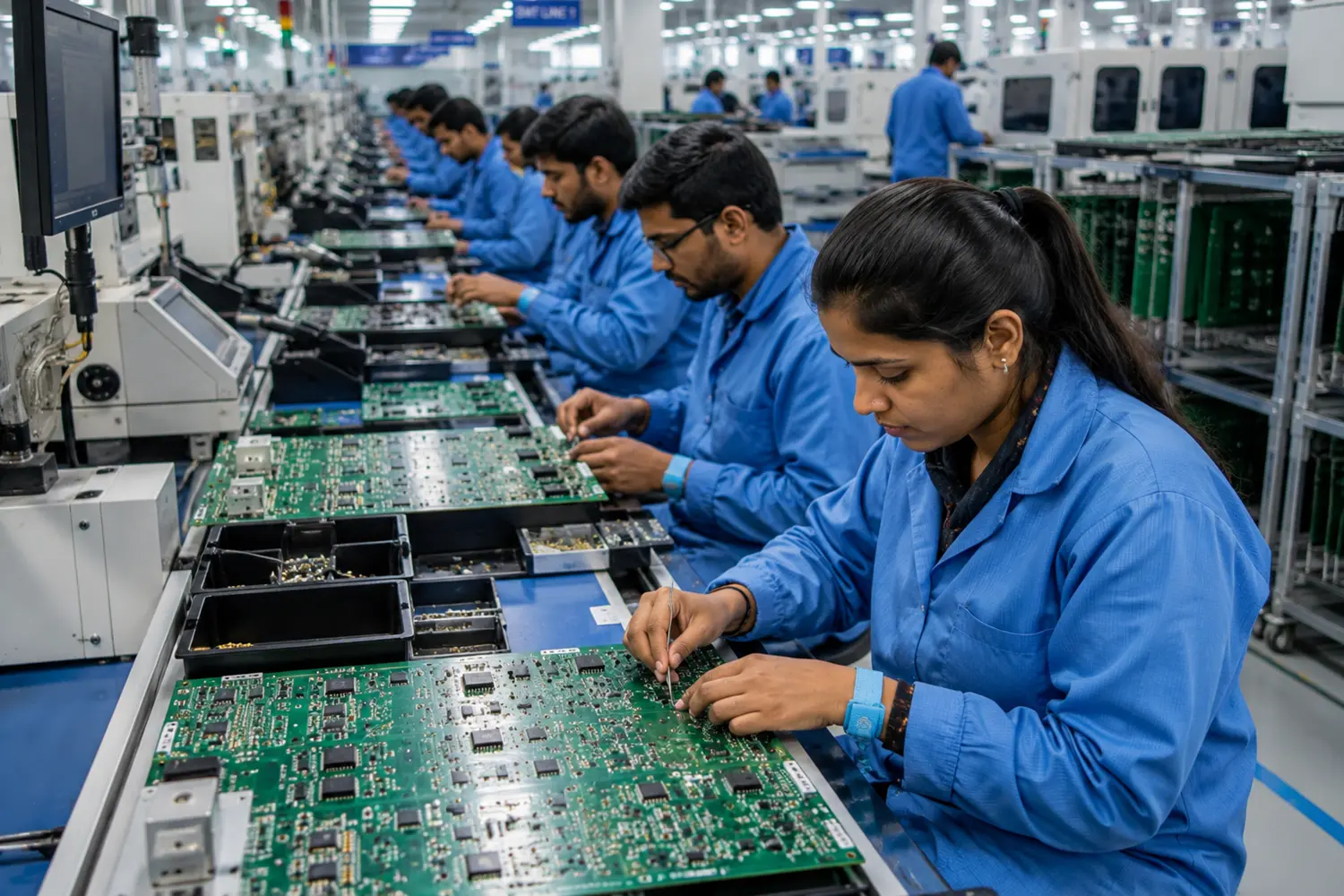
India's PCB market has grown from approximately $2.9 billion in 2019 to an estimated $5.8 billion in 2024, representing a compound annual growth rate (CAGR) exceeding 15%. While India currently accounts for only about 3.5% of global PCB production — compared to China's dominant 50%+ share — the trajectory is unmistakably upward.
India imports approximately 65-70% of its PCB requirements, primarily from China, Taiwan, and South Korea. This heavy import dependence represents both a vulnerability and a massive opportunity for domestic manufacturers. The Indian government has identified PCB manufacturing as a strategic priority sector, recognizing that electronics self-sufficiency is essential for national security and economic sovereignty.
Key Statistic
India's electronics manufacturing sector is projected to reach $300 billion by 2026, with PCBs forming the foundational component of this growth. Every dollar of electronics production drives approximately 5-8 cents of PCB demand.
2. Key Growth Drivers
Several convergent forces are propelling India's PCB market growth:
2.1 Domestic Electronics Consumption Boom
India is the world's second-largest smartphone market with over 1.1 billion mobile connections and growing. Rising middle-class incomes, increasing urbanization, and government-led digitalization initiatives (Digital India, Smart Cities Mission) are driving unprecedented demand for consumer electronics, IoT devices, and connected infrastructure — all of which require PCBs.
2.2 Supply Chain Diversification (China+1 Strategy)
Geopolitical tensions, COVID-era supply chain disruptions, and rising labour costs in China have accelerated the global "China+1" diversification strategy. Multinational corporations are actively seeking alternative manufacturing locations, and India — with its large workforce, improving infrastructure, and government incentives — is a primary beneficiary. Major EMS (Electronics Manufacturing Services) companies including Foxconn, Flex, and Jabil have significantly expanded their Indian operations.
2.3 PLI Schemes & Fiscal Incentives
The Government of India's Production Linked Incentive (PLI) schemes — covering electronics manufacturing, IT hardware, telecom equipment, and automotive components — offer 4-6% incentives on incremental sales for qualifying manufacturers. The Scheme for Promotion of Manufacturing of Electronic Components and Semiconductors (SPECS) provides 25% capital expenditure reimbursement for PCB and component manufacturing.
3. Make in India & Government Initiatives
The Make in India initiative, launched in 2014, has evolved into a comprehensive industrial policy framework. For the PCB sector, key policies include:
- Electronics Manufacturing Clusters (EMC 2.0): Developing world-class infrastructure with common facilities for PCB fabrication, testing, and effluent treatment in dedicated industrial parks.
- Modified Special Incentive Package Scheme (M-SIPS): Providing capital subsidies of 20-25% for electronics manufacturing investments in non-SEZ areas.
- Phased Manufacturing Programme (PMP): Gradually increasing import duties on PCBs and components to incentivize domestic value addition — PCB import duties have risen from 0% to 10-15% over recent years.
- India Semiconductor Mission (ISM): While focused on chip fabrication, the $10 billion ISM also supports the PCB ecosystem through backward integration and technology development.
4. Defence & Aerospace Sector
The defence and aerospace sector represents one of the highest-value opportunities for Indian PCB manufacturers. India is the world's third-largest defence spender with an annual budget exceeding $75 billion, and the government has set a target of $5 billion in defence exports by 2025.
The Defence Acquisition Procedure (DAP) 2020 mandates increasing indigenous content across all procurement categories, with the highest preference for "Buy (Indian-IDDM)" — Indigenously Designed, Developed, and Manufactured. This creates substantial demand for domestically produced MIL-SPEC PCBs for radar systems, electronic warfare equipment, missile guidance, secure communications, and UAV avionics.
AEAR is proud to be a contributor to this ecosystem, manufacturing high-reliability PCBs that meet IPC Class 3 and MIL-PRF standards for defence applications.
5. Automotive & EV Opportunities
India's automotive sector — the world's fourth-largest by vehicle production — is undergoing a fundamental transformation driven by electrification. The Indian EV market is projected to grow at a CAGR of 44% between 2024 and 2030, reaching over 10 million units annually.
EVs contain 3-5× more PCB content than internal combustion engine vehicles, with high-value boards in battery management systems (BMS), on-board chargers, DC-DC converters, motor controllers, ADAS sensors, and infotainment systems. This represents a multi-billion-dollar PCB opportunity that Indian manufacturers are well-positioned to capture, particularly as automotive OEMs seek localized supply chains under the Automotive PLI scheme ($3.5 billion allocation).
6. Consumer Electronics & Telecom
The consumer electronics and telecommunications sectors remain the volume drivers of India's PCB market. Key trends include:
- 5G Rollout: India's 5G network deployment — one of the fastest in the world — is generating massive demand for high-frequency PCBs for base stations, antennas, and network infrastructure. Telecom equipment manufacturing in India is targeted to reach $40 billion by 2027.
- Smartphone Manufacturing: India now produces over 250 million smartphones annually, with Apple manufacturing iPhone 15 and later models in India through Foxconn and Tata Electronics. Each smartphone requires 10-15 PCBs including main boards, flex circuits, and module substrates.
- Data Centre Expansion: With data localization policies and growing cloud adoption, India's data centre capacity is expected to triple by 2028, driving demand for server motherboards, backplane PCBs, and networking equipment boards.
7. Challenges Facing the Indian PCB Industry
Despite the promising outlook, the Indian PCB industry faces significant challenges that must be addressed:
- Raw Material Dependency: India imports virtually all PCB raw materials — copper-clad laminates, prepreg, solder mask, and specialty chemicals — primarily from China and Taiwan. Developing a domestic supply chain for these materials is critical for long-term competitiveness.
- Technology Gap: While India has strong capabilities in standard multilayer PCBs (up to 8-12 layers), the country currently lacks sufficient capacity for advanced technologies like HDI, any-layer via, IC substrates, and ultra-high-layer-count boards (> 20 layers).
- Skilled Workforce: PCB manufacturing requires specialized skills in chemical processing, photolithography, CNC operation, and quality control. Expanding vocational training and industry-academia partnerships is essential.
- Capital Intensity: State-of-the-art PCB fabrication facilities require investments of $50-200 million. Access to affordable capital — particularly for mid-sized manufacturers — remains a constraint.
- Environmental Compliance: PCB manufacturing generates hazardous waste (etchants, plating solutions). Stricter environmental regulations require significant investment in effluent treatment and zero-liquid-discharge systems.
8. Market Forecast 2024-2030
Based on current trends and policy trajectories, the AEAR market analysis team projects the following for India's PCB industry through 2030:
- Market size: Growing from $5.8 billion (2024) to approximately $14.5 billion by 2030, at a CAGR of 16.1%.
- Domestic production share: Increasing from ~30% to 45-50% of domestic consumption, driven by import substitution and PLI incentives.
- Employment: Direct employment in PCB manufacturing projected to grow from approximately 80,000 to 250,000+.
- Exports: PCB exports from India projected to reach $2-3 billion by 2030, up from under $500 million currently, as Indian manufacturers achieve global quality certifications and cost competitiveness.
- HID growth: HDI and advanced PCB capacity expected to grow at 25%+ CAGR as manufacturers invest in laser drilling, plasma etching, and advanced plating lines.
9. Conclusion & Strategic Outlook
The Indian PCB market is at an inflection point. The convergence of massive domestic demand, supportive government policy, global supply chain realignment, and increasing investment in manufacturing capacity creates a once-in-a-generation opportunity for the Indian PCB industry to establish itself as a global force.
At AEAR, we are committed to being at the forefront of this transformation — investing in advanced manufacturing capabilities, pursuing international quality certifications, and partnering with defence, aerospace, automotive, and industrial clients to deliver PCBs that meet world-class standards. As India's electronics manufacturing ecosystem matures, AEAR will continue to grow alongside it, powering the nation's technological ambitions one circuit board at a time.
Partner with AEAR for Indian PCB Manufacturing
✓ Strategically located manufacturing facility in Rajasthan, India | ✓ Capabilities from prototype to volume production | ✓ Serving defence, aerospace, automotive & industrial clients globally | ✓ Competitive pricing with Make in India advantages | ✓ ISO-certified quality management | Contact us for your PCB requirements.
Rohan Mehta
Excellent market analysis! The PLI scheme numbers are on point. As someone running a PCB manufacturing unit in Pune, I can confirm the 16.1% CAGR projection is realistic — our order book has grown 40% YoY. The raw material dependency on China remains the biggest bottleneck though.
Priya Williams
Great overview of the Indian PCB landscape. The defence sector opportunity is particularly exciting — with the government's push for indigenous content, companies like AEAR are perfectly positioned. Would be interesting to see a comparison with Vietnam and Thailand as alternative China+1 destinations.
Sanjay Gupta
The 5G rollout impact on PCB demand is understated — we're seeing massive orders for base station boards and the specs are brutal (low-loss materials, tight impedance control at mmWave). India's PCB industry needs to rapidly upskill for this segment or risk losing it to established players.